From AI Hype to Enterprise Reality: The Dilemma Facing Today’s Technology Leaders

Over the last few months, I’ve had dozens of conversations with CIOs, CTOs, and CDOs across banking, government, telecom, healthcare, and other large enterprises.

Despite all the attention around generative AI and agentic AI, the sentiment among technology leaders is still surprisingly divided.

I generally see two very different camps.

One group, especially in highly regulated industries, remains deeply skeptical. They are cautious for good reason. Concerns around security, governance, compliance, and trust are still very real.

The other group wants to move faster, but they are overwhelmed. The pace of innovation is relentless. New models, tools, frameworks, and platforms keep appearing almost every week. For many leaders, the challenge is not whether AI matters. It is deciding where to begin, what to prioritize, and how to move without creating unnecessary risk or wasted investment.

Both perspectives are understandable. But they highlight the same underlying issue.

The hype around AI has not translated easily into enterprise adoption.

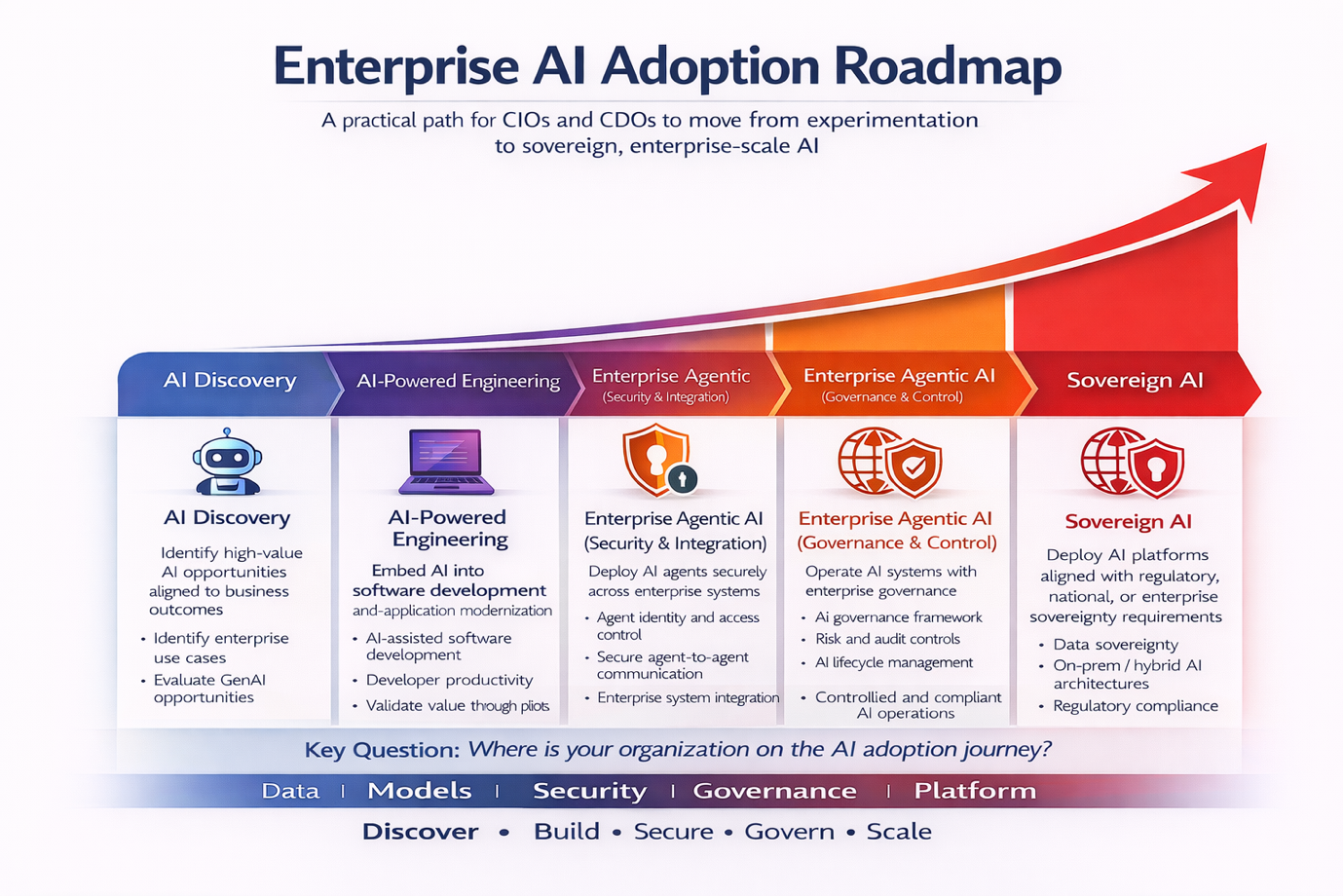
The missing piece for many organizations is a clear roadmap for how AI adoption should progress inside an enterprise environment.

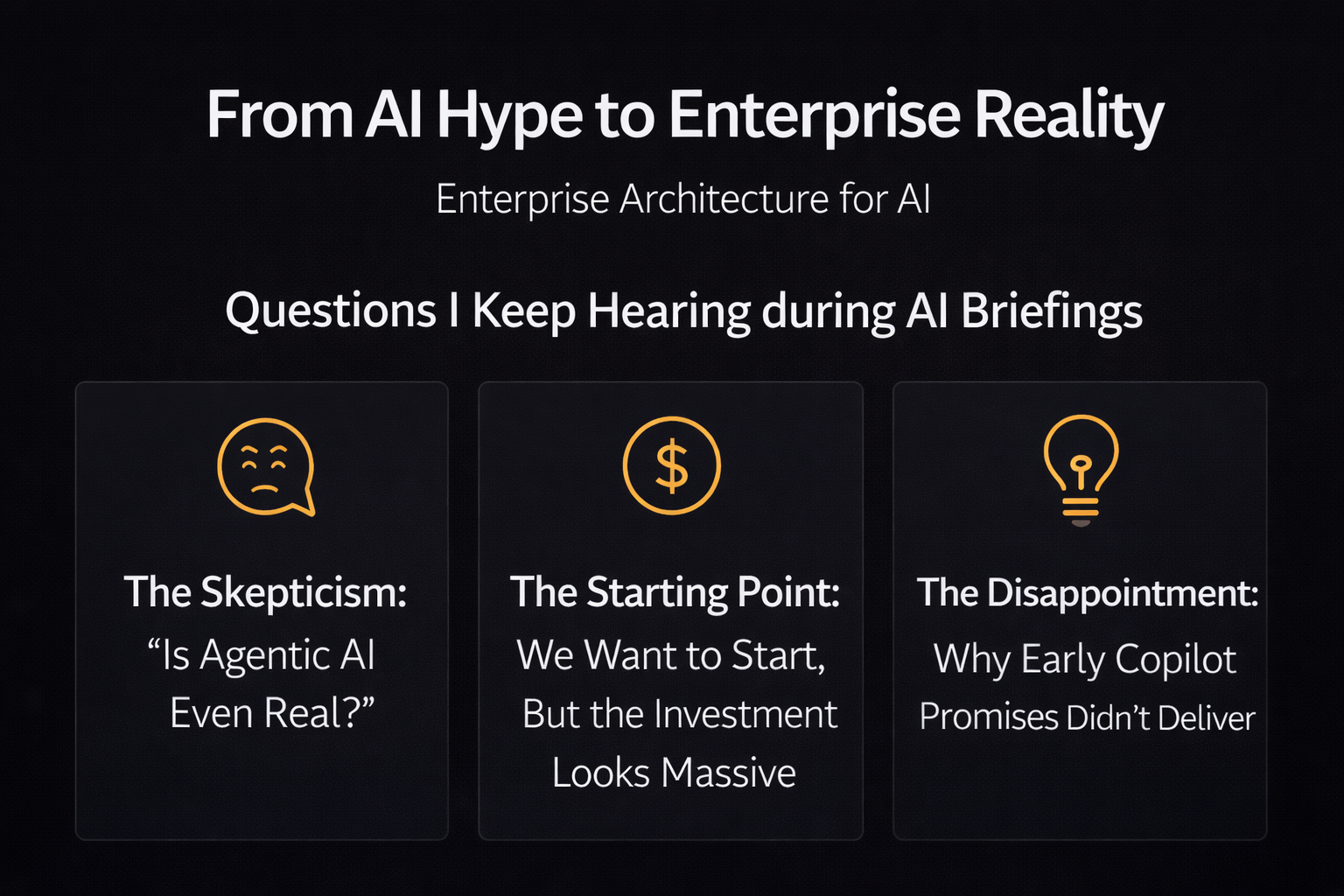
The Skepticism: “Is Agentic AI Even Real?”

Many CTOs in highly regulated industries are questioning whether agentic AI is practical today.

Their concerns are legitimate. They see:

  • AI systems behaving like black boxes
  • Security risks in autonomous agents
  • Lack of explainability
  • Unclear governance models

For organizations operating under strict regulatory frameworks, this raises a simple but critical question: Is this technology mature enough to trust with critical business processes? Because of these risks, many leaders are not pursuing incremental improvements.
Instead, they are waiting for a large breakthrough use case that justifies the risk of adoption.

But this expectation can delay meaningful progress.

The Reality: Agentic AI Does Not Mean Full Autonomy

One of the biggest misconceptions about agentic AI is that it must behave like a fully autonomous system, similar to self-driving cars.

We are not there yet.

And more importantly:

Enterprise AI does not require full autonomy to create business value.

In practice, the most successful implementations today operate at different levels of autonomy.

Narrow-Scope Agents

These agents operate with:

  • defined tools
  • limited decision boundaries
  • structured workflows

Architecturally, they behave more like intelligent backend services.

This approach provides something enterprises care deeply about: behavioural consistency and predictability.

In many organizations, these types of agents already deliver meaningful benefits in areas such as:

  • workflow automation
  • engineering productivity
  • operational support

More Autonomous Agents

In low-risk domains such as knowledge management or internal assistance, agents can operate with greater autonomy.

Examples include:

  • research assistants
  • internal knowledge agents
  • productivity assistants

These systems tolerate more variability because the risk profile is lower.

One reason agentic AI has been over-hyped is that some vendors promote the idea of a single universal agent platform doing everything.

In reality, enterprise AI architectures will likely consist of multiple agents with varying levels of autonomy, each designed for specific use cases.

The Other Dilemma: “We Want to Start, But the Investment Looks Massive”

The second group of leaders I meet are enthusiastic about AI but overwhelmed by the perceived cost.

They see rapid advances in:

  • models
  • infrastructure
  • frameworks
  • tooling

And they worry that by the time they make a large investment, the technology may already be obsolete.

This fear often leads to analysis paralysis.

But the reality is much simpler.

You do not need massive upfront investment to begin the enterprise AI journey.

In fact, large “big bang” AI initiatives often fail.

The more practical approach is straightforward:

  1. Identify a real business problem
  2. Run a targeted experiment
  3. Deploy the solution in production
  4. Expand once the value is proven

AI adoption works best when it follows an iterative maturity journey, not a single transformation program.

Why Early Copilot Promises Didn’t Always Deliver

Another frustration I frequently hear relates to the early wave of AI copilots.

Many organizations expected dramatic productivity gains.

But the outcomes were mixed.

That is because most copilots focused on individual productivity, such as:

  • email summarization
  • document drafting
  • search assistance

While useful, these improvements do not necessarily translate into enterprise-level ROI.

The deeper productivity gains come from something else entirely:

the readiness of enterprise systems behind the AI.

Enterprise-level AI productivity requires:

  • integrated enterprise data
  • modern application architectures
  • strong security models
  • governance frameworks

What works for general productivity use cases does not automatically translate to enterprise environments.

In many cases, organizations rushed to become “GenAI ready” without first ensuring their enterprise platforms were AI ready.

.

A Practical Approach: Start Small, Scale Intelligently

The organizations that succeed with AI are not the ones chasing every new breakthrough.

They are the ones who:

  • start with real business problems
  • validate outcomes through experimentation
  • deploy incrementally
  • scale once value is proven

AI adoption is less about technology breakthroughs and more about organizational readiness and disciplined execution.

How IBM Can Help

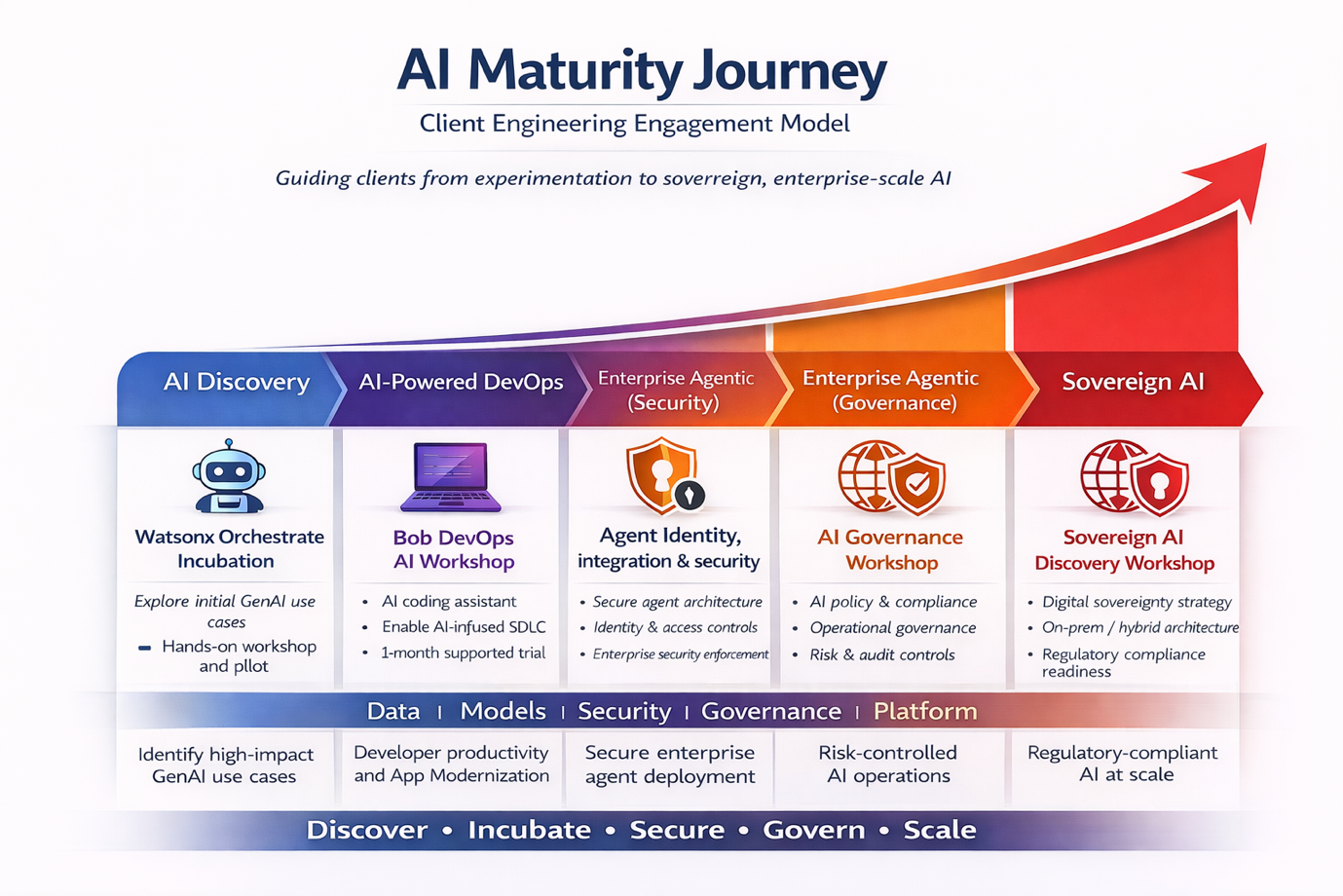
At IBM, our Client Engineering teams work closely with organizations to navigate this journey.

Rather than starting with technology, we begin with business outcomes and real use cases aligned to your Business transformation Journey.
The Key Question for Every CIO and CDO

Every enterprise today is at a different stage of its AI adoption journey.

The real question is not whether AI will transform your organization.

It will.

The more important question is where you are today — and what capability you need to build next to move forward with confidence.

My take is that , the organizations that get that right will move beyond the hype and start realizing real value from AI.

Feel free to reach out if you would like to continue the discussion.

Agentic AI in APAC: Navigating the Path from Pilot to Production

Agentic AI in APAC: Navigating the Path from Pilot to Production

This blog post is a follow-up to what I shared at our recent meetup organized by AI Verify, where over 100 members of our community joined us at IMDA to share and learn real-world stories about making Agentic AI reliable.

The Asia-Pacific region is witnessing a significant shift in how organizations approach artificial intelligence, moving beyond traditional AI implementations toward more autonomous, agentic systems. Based on our recent pilot programs with enterprise customers across APAC, we’re seeing distinct patterns emerge in adoption strategies, use cases, and implementation challenges.

Current Adoption Patterns: What Our Pilot Data Reveals

Our customer pilot programs have provided valuable insights into how organizations are actually utilizing agentic AI capabilities. The data reveals interesting trends in feature adoption:

Tool Usage leads the way at 45% adoption, indicating that organizations are primarily leveraging AI agents’ ability to interact with existing software tools and APIs. This suggests a pragmatic approach where companies are extending their current technology stack rather than replacing it entirely.

Multi-Agent Systems follow at a notable 70% adoption rate, demonstrating strong interest in deploying multiple specialized agents that can collaborate on complex tasks. This high adoption rate indicates that APAC organizations recognize the value of distributed AI capabilities.

Reflection capabilities show 15% adoption, suggesting that while organizations value AI systems that can self-evaluate and improve their responses, this remains a more advanced feature that requires additional organizational maturity.

Action-oriented implementations currently represent 5% of adoption, indicating that while there’s interest in AI systems that can take direct actions, most organizations are still in the monitoring and recommendation phase. This low adoption rate reflects the preference for human-in-the-loop approaches, where AI agents recommend actions but require human approval before execution, ensuring oversight and control over critical business decisions.

Top 5 Use Cases Driving APAC Adoption

1. Software Development Lifecycle (SDLC)

Organizations are implementing agentic AI to automate code review processes, generate test cases, and assist in deployment pipelines. The ability of AI agents to understand context across multiple development phases makes them particularly valuable for streamlining software delivery.

2. Deep Research and Analysis

Companies are deploying AI agents to conduct comprehensive market research, competitive analysis, and regulatory compliance reviews. These agents can process vast amounts of unstructured data and synthesize findings across multiple sources and languages—particularly valuable in APAC’s diverse regulatory landscape. For example, financial institutions are using AI agents to research source of wealth documentation and process commercial loan company profiles, automatically gathering and analyzing corporate filings, news articles, and regulatory records to build comprehensive risk assessments.

3. Manufacturing Process Automation

Manufacturing companies are using agentic AI to optimize production schedules, predict maintenance needs, and coordinate supply chain activities. AI agents can adapt to changing production requirements and coordinate across multiple systems in real-time. A notable application is in new product design research, where AI agents analyze market trends, competitor products, regulatory requirements, and technical specifications to provide comprehensive insights that inform product development decisions and accelerate time-to-market.

4. Sales Insights and Customer Experience

Organizations are implementing AI agents to analyze customer interactions, predict purchase behavior, and personalize engagement strategies. These systems can process customer data across multiple touchpoints and provide actionable insights for sales teams.

5. Procurement Process Automation

Companies are streamlining procurement workflows using AI agents that can evaluate suppliers, negotiate contracts, and manage purchase orders. These agents can adapt to changing market conditions and organizational requirements while maintaining compliance standards.

Three Distinct Adopter Profiles

Our experience across APAC markets has revealed three primary adoption patterns:

Early Adopters: The “Agentic” Pioneers

These organizations are enthusiastic about becoming “agentic” and focus on automating existing workflows. They’re willing to experiment with newer technologies and often serve as proof-of-concept environments for more advanced AI capabilities. Early adopters typically have strong technical teams and leadership buy-in for AI initiatives.

Stack Builders: Long-term Strategic Planners

Stack Builders approach agentic AI with enterprise-wide adoption in mind. They start with simple, well-defined use cases while building the infrastructure and organizational capabilities needed for broader deployment. These organizations prioritize scalability and integration with existing enterprise systems.

Pragmatic Adopters: Embedded Solution Seekers

Pragmatic adopters prefer implementing agentic AI through embedded applications in platforms they already use, such as Salesforce or Microsoft 365. They focus on immediate business value and prefer solutions that require minimal change to existing processes and user behavior.

Key Implementation Challenges

Despite growing interest, organizations face several significant hurdles in scaling agentic AI implementations:

Business Readiness for Dynamic Workflows

Traditional business processes are designed for predictability and control. Agentic AI introduces dynamic decision-making that can feel unpredictable to stakeholders. Organizations struggle with the cultural shift required to trust AI agents with important business decisions, particularly in risk-averse cultures common across many APAC markets.

Quantification of Business Outcomes

Measuring the ROI of agentic AI implementations remains challenging. Unlike traditional automation projects with clear metrics, agentic systems often provide value through improved decision quality, faster response times, and enhanced adaptability—benefits that are difficult to quantify using conventional business metrics.

Access to Source Systems

Many organizations have data and systems scattered across multiple platforms, often with limited API access or integration capabilities. Agentic AI requires comprehensive data access to function effectively, but legacy systems and data silos create significant technical barriers to implementation.

Cost of Manual Data for Evaluation

Evaluating agentic AI performance requires significant manual effort to create test datasets, validate outputs, and assess decision quality. Organizations underestimate the ongoing cost of maintaining evaluation frameworks, particularly when AI agents are deployed across multiple use cases with different success criteria.

Looking Forward: The Path to Maturity

The APAC market’s approach to agentic AI reflects broader regional characteristics: thoughtful adoption, emphasis on practical business outcomes, and careful risk management. Organizations that succeed in scaling agentic AI implementations will likely be those that address the fundamental challenges of trust, measurement, and integration while building organizational capabilities for managing dynamic AI systems.

Two critical factors will determine scalability success: agent observability and cost optimization. Agent observability—the ability to monitor, debug, and understand AI agent decision-making processes in real-time—is essential for building organizational trust and ensuring reliable performance at scale. Without clear visibility into how agents make decisions, organizations struggle to troubleshoot issues, optimize performance, and maintain compliance standards.

Equally important is managing the cost of the solution, which becomes a key barrier to scale. While pilot programs may absorb higher per-token costs, enterprise-wide deployment requires sustainable economic models. Organizations need to factor in not just the direct costs of AI infrastructure, but also the ongoing expenses of monitoring, evaluation, human oversight, and system integration.

As the technology matures and more organizations share their implementation experiences, we expect to see standardized evaluation frameworks, improved integration capabilities, and greater organizational comfort with AI-driven decision-making. The current pilot phase is laying the groundwork for more widespread adoption across the region.